Showing posts with label Marx Brothers. Show all posts

21 June 2025

A Medical "Procedure" Sniffles, Knee Pain, Depression, Movies and the Brothers Marx All in One Short Post

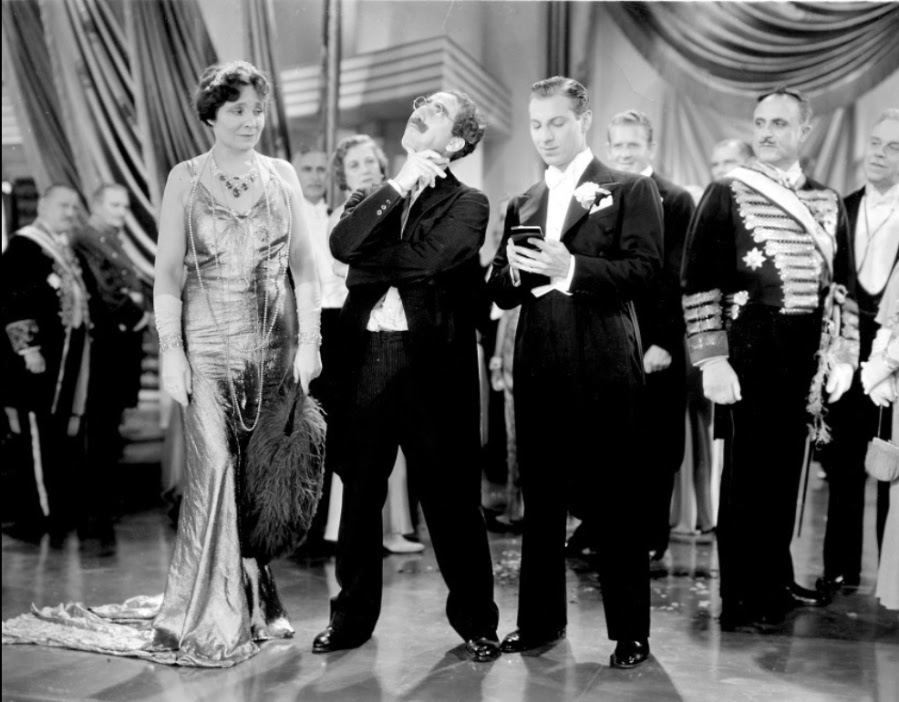
Duck Soup

I had an endoscopy on Wednesday.
(An endoscopy is a procedure used in medicine to look inside the body. The endoscopy procedure uses an endoscope to examine the interior of a hollow organ or cavity of the body. Unlike many other medical imaging techniques, endoscopes are inserted directly into the organ.) They put me to sleep then stuck a tube down my throat which took photos and did biopsies. That it can do a biopsy blows my mind. Modern medicine. The procedure took about twenty minutes. I was at the medical enter for a little bit over two hours. The first thirty minutes of which I was occupied with filling out forms and yakking with my wife who’d kindly accompanied me. She’s aces.

With insurance the visit and procedure set me back $100. That’s with medical insurance. Without insurance the cost would have been prohibitive and I’d have had to taken my chances that nothing was amiss.


Thursday was Juneteenth so I had an extra day to relax. It wasn’t the happiest day of my life. I’ve had a horrible case of the sniffles with constant sneezing and a nose running like the Colorado River after a monsoon. No other symptoms. I was also wracked with depression, a particularly bad case. Depression can be like a terrible pain that has no discernible source, it’s just there beating the hell out of you. On top of the sniffles and the blues I have a pain in my right leg that seems centered around my knee. I don’t know what it is or where it came from. It’s been around for a few days but yesterday was the first time it really bothered me. Calling the doctor later.


I wiled the day away with movies, reading and naps. Wednesday after I got home from the “procedure” was the same. I watched Bridge on the River Kwai (1957) Lean. I hadn’t seen it in I’ve no idea how long but I know I’ve seen it a lot because throughout the movie in addition to knowing what was about to happen I knew what lines were about to be said — verbatim. It’s quite a remarkable film in many ways. I remember as a kid I thought it had the coolest ending ever. Oh the irony! (I was precocious when it came to irony.) But the key to the film is William Holden. He can turn a good movie into a great one. No one has ever been a better or more affable cynic. 


In the evening the missus and I finished Dept. Q on Netflix. What a terrific show. Matthew Goode played against type starring as the angry, troubled but brilliant detective.


Thursday I watched The Big Trail (1930) Walsh. Much of the acting is wooden and uninteresting, especially from the lead, one John Wayne in his first starring role, but it is an otherwise amazing film shot in widescreen (yes, in 1930!) on location. It looks nothing like other films of the era. It surely gives you a feel for what life on a real wagon train must have looked like. It’s got everything but the smells. A remarkable achievement well ahead of its time.


With the depression weighing on me in the evening I did the best I could to withstand it by watching the greatest comedy of all time Duck Soup (1933) McCarey. To suggest that they don’t make comedies like that anymore is a massive understatement. It’s only a shame that I’ve watched it so many times that I know the gags by heart. Imagine watching the mirror scene for the first time! I remember that when I did watch it for the first time as a child I thought it was magical, surreal and hilarious and utterly wonderful. Same with the stateroom scene in A Night at the Opera. Duck Soup was the last film the brothers Marx made before Irving Thalberg Hollywoodized them by adding sappy songs and boring love stories. The first of those films was the afore-mentioned Night at the Opera which ranks right behind Duck Soup, Horsefeathers, Monkey Business and Animal Crackers as among their best work. The subsequent films pale in comparison.


Okay so I started this Friday morning before heading off to work and I finish it now on Saturday morning. The sniffles persist but are not nearly so bad, the knee pain has also abated somewhat but clearly I need to have it checked out. I’m assuming that the doctor’s office will return my call sometime Monday. I guess they’re too understaffed to return patients’ calls. God forbid I had an emergency. The depression is gone — for now — but it lurks and one never knows when it will next strike. It’s a right bastard.


Going for a long walk in a bit. May accidentally swing by a bookstore. These things happen.

27 November 2023

Turkey, Movies, Basketball and Stuck in a Tunnel, My Four-Day Weekend

The Marx Brothers in Horse Feathers

My four-day weekend began with the end of my work day on Wednesday afternoon. Two hours after lunch I went to the gym for a vigorous workout. Back home my lovely wife made dinner and I graciously consented to eat it. In the evening I watched one of my favorite films of all time, Ice Storm (1997) Lee. I often watch it on Thanksgiving Eve as it is set during the Thanksgiving weekend of 1973.

I spent the first part of Turkey Day reading and watching a movie on Criterion Channel called, Safe in Hell (1931) Wellman, a very pre-code film that I much enjoyed. Then it was off to my sister-in-law’s house for dinner. In attendance were the missus, my daughters, my nephews, a niece, significant others, five children, my sister-in-law, a dog and one person who was not family who I never got to know. I had a grand time chatting with kinfolk, playing with children and petting and sneaking food to the dog. I also ate quite a bit of food as one is prone to doing on this particular occasion. I feel safe in saying a good time was had by all.


The next day I went to a women’s basketball game as Cal hosted game one of their tourney. Our heroes bested San Jose State. I then walked to Moe’s bookstore to look for a gift for younger daughter who shares her dad’s passion for reading. I found nothing suitable but enjoyed my time in one of the world’s best bookstores.


I returned home to find both daughters visiting and of course enjoyed their company. In the evening I watched my second favorite Marx Brothers film, Horse Feathers (1932) McLeod. Despite this being my umpteenth viewing it I managed several chuckles, guffaws, titters, hardy-har-hars and belly laughs.


Saturday started with me watching my favorite English football (that’s soccer to you Yanks) team (Arsenal) win on a late goal. I did my happy dance. Then it was off to the second day of the tourney. This time a Bear team depleted by injuries lost. The game was even for three quarters but the exhausted locals faded at the end. Never mind it was a good day.


At home it was movie time again. The missus and I watched Godland (2022) Pálmason on DVD. My copy had only just arrived, I’d pre-ordered it not long after watching it for the first time on the Criterion Channel.  A great film is always better the second time. This was followed by watching my favorite college football team, the University of California Golden Bears, defeat UCLA in a stunning upset, 33-7. Two great wins on telly for the day with a loss in person sandwiched in between. Fair return.


Sunday morning I spent a fair bit of time with the Sunday New York Times. Mostly I was reading it. Having poured through a majority of it, the missus and I embarked on our big adventure. We went into San Francisco to see the latest movie from the great Finnish director, Aki Kaurismäki, Fallen Leaves. The closure of virtually all of Berkeley’s theaters necessitated making the long journey. We went to the Opera Plaza Landmark cinema which is a stone’s throw from Civic Center. That meant walking from the BART station past all variety of mendicants, tramps, loonies, methheads, and paranoid schizophrenics. As a social worker, this is younger daughter’s clientele. Lucky.


The theater was tiny — no, microscopic -- with only three rows but the seats — dear god, they were comfy, you sank into them. The movie was sublime, in other words, typical  Kaurismäki. From there we dodged the hoi polloi and made our way back to the subway and what we assumed would be a pleasant and quick journey back to Berkeley. But fate intervened — as it so often does.


Just outside Oakland’s 12th Street Station the train stopped. And stayed stopped. At one point the lights went out. That terror (slight exaggeration) lasted only half a minute. But the tedium of sitting on a train in a tunnel continued. Of course my wife went about chattering with other passengers, meanwhile my mood plunged, my anxiety rose. I took an Ativan. It helped a bit. We were constantly thanked for our patience and apologized to. Never helps. Finally a “rescue” train arrived. We had to walk to the back of our train where we were told we would “cross over.” I did not like the use of this phrase as it invoked what many people refer to as dying. Nonetheless we soldiered on and literally stepped over a small plank onto another train. I gave our driver a parting fist bump.


Again we sat for awhile but eventually were on our way and arrived safely in Berkeley. We decided to treat ourselves after the trauma of being tunnel-bound by having dinner at a local eatery. From there it was home sweet home.


The rest of the evening hardly deserves mention though it did entail washing towels, reading and watching a spot of TV before retiring for the evening. All told not a bad weekend. How was yours?

03 April 2023

I Examine the Question: Who is My Favorite Actor, Then I Answer it

Cary Grant

Someone asked me recently who my favorite actor is. Oh my. There’s so many sides to that question. Am I looking at someone who consistently gave or gives great performances? Am I leaning toward an actor who is in a lot of my favorite movies? Am I considering star quality? 

How do you compare Cary Grant and Robert DeNiro? They’re from different eras and were expected to do such different types of things. 

Grant is the first name that pops into my mind because he was in so many films that I love — His Girl Friday, Holiday, Talk of the Town, Notorious, The Awful Truth, Bringing Up Baby, Mr. Lucky, The Philadelphia Story, Suspicion. Many of them are comedies. Far from being disqualifying that’s a testament to his skills. Being a good comic actor is difficult and Grant was a great one. Grant couldn’t give a performance to match Brando in Streetcar Named Desire (who can?) but then again we’re talking about favorites here not best.


Al Pacino is the second actor who comes to mind. He’s given some of the greatest lead acting performances I’ve ever seen including in three cinematic classics: The Godfather, The Godfather Part 2 and Dog Day Afternoon. He was brilliant as a supporting player in Once Upon a Time In Hollywood. He was never better than in Donne Brasco, a lesser film that he stole. He also shone in Serpico, And Justice for All, Panic in Needle Park, The Irishmen, Heat, Insomnia, Scarecrow and Glengarry Glen Ross. I think he’s the greatest actor of the past fifty years. 


My third candidate is Humphrey Bogart. Arguably he’s more star than actor then again he certainly did some serious acting in Treasure of the Sierra Madre and The African Queen. He wasn’t merely standing there reading from the script in Casablanca, The Big Sleep, The Maltese Falcon, Petrified Forest, To Have and Have Not, Dark Passage or Key Largo. Bogart had such on screen presence he could practically make a film just by showing up and he was made for certain roles such as Philip Marlow, Sam Spade and Rick Blaine.


Al Pacino
In scanning my extensive collection of DVDs I note that the actor who appears the most is Max Von Sydow. Many of these are Bergman films such as The Seventh Seal, Winter Light and The Virgin Spring, but he’s also in two films — The Emigrants and the New Land — by another Swedish director, Jan Troell as well as several American films including Hannah and Her Sisters, the Exorcist, Shutter Island, Three Days of the Condor and as the narrator in Europa. I absolutely love his work, he made a lot of good films even better including some of the best in cinema history.

The previously mentioned Robert DeNiro also shows up in a lot of my DVDs: Goodfellas, Taxi Driver, Raging Bull, Mean Streets the King of Comedy, The Godfather Part 2, Silver Linings Playbook, Jackie Brown, The Deer Hunter and Heat. Wow. And so many iconic performances. His turns as Travis Bickle, Jake LaMotta and the young Vito Coreleone are enough to hang a career on, three careers.


I also like Paul Newman who somehow didn’t win an Oscar for either Hud or The Verdict. Unfortunately Newman’s career including an inordinate number of clunkers and few great films. Of course he was memorable in two films with Robert Redford —Butch Cassidy and the Sundance Kid and the Sting. Redford is another beloved actor who lit up the screen in The Candidate, All the President’s Men, Downhill Racer and Three Days of the Condor but he was never a great actor at least not in comparison to the likes of DeNiro and Pacino


Dustin Hoffman is unquestionably a great actor as are Daniel Day Lewis, Tom Hanks, Anthony Hopkins and Denzel Washington but none of them are enough of my favorite films.


I’m a big fan of Malcolm McDowell but there’s not much to him besides If…. And A Clockwork Orange.


Oh my, I've forgotten Jack Nicholson (Chinatown, The Shining, The Last Detail, Five Easy Pieces). 


I love William Holden who was so good in Sunset Blvd. Stalag 17, Bridge on the River Kwai and Network but that’s not quite extensive enough a list. Similarly I’m a fan of Burt Lancaster but he doesn’t have enough on his resume either.


James Stewart appears in a lot of good to great films and was amazing in Mr. Smith Goes to Washington but I’ve never fully warmed up to the person he was and that counts for something when you’re talking about favorites. 


I also love Charlie Chaplin —doesn’t everyone? Notably he spent the overwhelming majority of his film career as the Little Tramp character, a different sort of acting. But as a potential favorite he has to rank high.


So too Groucho Marx who essentially played the same character throughout his film career but he did it so well and in so many great comedies.


Marcello Mastrioni
Let’s see I haven’t mentioned William Powell or Jack Lemmon or Woody Allen (he's also been in a lot of my favorites and has directed himself in many) or Leonardo DiCaprio or Henry Fonda or Steve McQueen. My god, McQueen, certainly my favorite actor from the first half of my life and still someone whose work I greatly admire. The Great Escape, Bullitt and Getaway are great examples of star performances by Mr. Cool.


And other than Von Sydow I’ve mentioned no actors from foreign language films. I’ll remedy that by invoking the name of Marcello Mastrioni who was both a “star” and a talented actor. I love him in La Dolce Vita, 8 1/2, La Notte, The Organizer, and A Special Day. Then there’s Jean Gabin who starred in such films as La Grande Illusion, Port of Shadows and The Lower Depths. Matti Pellonpää featured in many of Aki Kaurismäki’s early films including Shadows in Paradise, La Vie Da Bohme and Jim Jarmusch’s Night on Earth. Can’t forget Toshiro Mifune a regular in Akira Kurosawa’s films of the fifties. The Swiss actor, Bruno Gansz deserves a mention for his many roles in German films such as Downfall and Wings of Desire.


Okay, it’s time to fish or cut bait, so who’s my favorite? I’m going with three. My favorite from the first half of the 20th century is Cary Grant, as previously suggested, my favorite after that is Al Pacino and my favorite foreign language actor is Marcello Mastrioni.


Coming up later this week: my favorite actress.

22 October 2021

From Chaplin to Chinatown My Ten Favorite Books on Films

Twelve Angry Men

I have a voracious appetite for books. Mostly I devour fiction or history but occasionally I combine two passions and read books about another great love, films. Here are brief reviews of ten books on films that I have especially enjoyed and highly recommend. Several of them are neither specifically about a particular film nor the works of a filmmaker, but all touch upon making movies in exploring their topic.

Reginald Rose and the Journey of 12 Angry Men by Phil Rosenzweig. This is an exploration of Reginald Rose who wrote the teleplay for 12 Angry Men (1957) Lumet, which he later adapted into the screenplay. The film, of course, is a Hollywood classic that has inspired countless theatrical versions, television parodies and remakes and has been used in classrooms to study everything from group dynamics, to the law itself. To say 12 Angry Men is one of America’s most important films is to understate it. Phil (I refer him to him by his first name because — full disclosure — he’s been a good friend since our high school days) introduces us to Rose, who besides 12 Angry Men, is also known for writing teleplays during TV’s golden age when brilliant anthology shows ruled the air waves. He also created an excellent (if little remembered) drama of the early sixties, The Defenders. Twelve Angry Men was the apex of a great career. (Rose was also co-producer, along with Henry Fonda.) It is a film worthy of study and re-study, as this wonderful book demonstrates.


Made Men the Story of Goodfellas by Glenn Kenny. A great film deserves books written about it and Kenny has done an admirable job writing about Goodfellas (1990) Scorsese. He seems to have had access to everyone involved, even tangentially, with the making of this Martin Scorsese classic. But this book does more than serve as a “the making of …” story, it also informs our love of the film, exploring why and how it has had such an impact on audiences and is watched and re-watched by cinephiles like me. As a book like this should, it will have you scrambling to watch it again, now with renewed appreciation.


Apropos of Nothing by Woody Allen. Allen’s sharp wit and keen intelligence are on full display in this wonderful chronicle of his life as a comedy writer, comic and most importantly, a filmmaker. Allen has always been a master story teller and Apropos is rife with the kind of wonderful and often hilarious stories that are so integral to entertainment lore. Of course, there’s plenty on his process of filmmaking, featuring his own self-effacing humor and self-criticism. It is an absolutely delightful read from beginning to end. 


The brothers Marx
Groucho, Harpo, Chico and Sometimes Zeppo A Celebration of the Marx Brothers by Joe Adamson. I bought this book over forty-five years ago and still haven’t found a better one about Marx Brothers’ films. The book is thoughtful, comprehensive and well-written. The author is clearly a fan of their work and happily celebrates their early classic films while bemoaning some of their weaker later efforts. There are stories and anecdotes aplenty in this  celebration of filmdom’s greatest comedy quartet (later trio).


Hitchcock by Francois Truffaut. Absolutely indispensable for anyone who loves films, particularly those with an appreciation for Hitchcock. The great French film director conducted a series of interviews with Hitchcock covering every one of Hitch’s film. It’s great fun to watch a Hitchcock film, then read what the master himself said about it. It helps that Truffaut was such an adept interviewer. We get real insights from the storyteller himself on just how he did it. (See also the documentary about the book.)


My Autobiography by Charlie Chaplin. One of the giants of filmmaking left behind this absorbing autobiography. It is rich with detail and chock full of stories from Hollywood’s early days through the early fifties. Among his many other talents, Chaplin was a good writer -- as this book displays. Also on display are his wit and charm. An absolute must for fans of the Little Tramp, the silent era and great films.


Pictures at a Revolution Five Movie at the Birth of the New Hollywood by Mark Harris. It’s hard to overstate what a good writer Harris is nor how diligent he is about research. He is a superior journalist who also writes engaging prose. His topic here are the five films from 1967 that were nominated for the Best Picture Academy Award. His main focus is on the two that helped revolutionize filmmaking (or at least were perfect examples of that revolution) Bonnie and Clyde (1967) Penn and The Graduate (1967) Nicholas. But he also explores the two that dealt frankly (for the times) with race, Guess Who’s Coming to Dinner (1967) Kramer and In the Heat of the Night (1967) Jewison. The fifth picture was Doctor Doolittle (1967) Fleischer which fits not at all with others but represents the dying gasps of old Hollywood. 


Images My Life in Film by Ingmar Bergman. Bergman is my favorite director so you can well imagine how much I love a book by the man himself. But anyone who appreciates the great Swede, or for that matter appreciates films, would enjoy this intimate look at his oeuvre. As one would hope (and seems to be the theme of this writing) Images enhances one’s appreciation of films just watched and has one scrambling to watch more. Filled with photos that enliven the text.


The Kid Stays in the Picture by Robert Evans. First the negative: Producer Robert Evans’ memoirs are, in the way of many such books, self-serving. What he omits could fill another couple of books and be compelling reading. That said this is damn entertaining. Evans worked in interesting times and was at the epicenter of Hollywood’s big changes in the late sixties/early seventies and was a key player in the makings of such classics as The Godfather (1972) Coppola and Chinatown (1974) Polanski. He knew everyone and they all knew him and here he tells the tales. It is a book rich with gossip but it also gives insight into how films are produced and how talent is developed and used or misused. 


"Forget it Jake, it's Chinatown."
The Big Goodbye: Chinatown and the Last Years of Hollywood by Sam Wasson. In writing this post I’ve been constantly tempted to write that this book is the best or most important of the lot. It is again very tempting in my final submission to the list. Like Goodfellas and 12 Angry Men, Chinatown is a towering American film deserving of a book or ten about it. Absent nine others, this will do nicely. Chinatown brought together some of the most important people in Hollywood at the time, the aforementioned producer Robert Evans, director Roman Polanski, screenwriter Robert Towne and star Jack Nicholson. The Big Goodbye tells the tale of how these giants came together and — sometimes in spite of each other — made a film that hasn’t aged a day since its release forty seven years ago. This is also a story of Hollywood at the time and the seismic changes that were going on in the film industry. It was after the collapse of both the studio system and the production code, when independent studios were making independent films with great directors creating the best decade of film the world has ever seen. We also see why and how that wouldn’t (or couldn’t last). Like all the other books on this list, a damn good read on a fascinating topic.

27 May 2021

The Unfunny Business of Describing Funny Movies, Plus the Difficulty of Creating Great Comedies, Plus Ten Greats From Ten Different Decades

Andy left Jorma right with Jimmy Fallon doing the Donkey Roll

"We'd like to get to the point where Connor is everywhere, like oxygen or gravity or clinical depression." -- From Pop Star: Never Stop Never Stopping

Yesterday I watched Pop Star: Never Stop Never Stopping (2016) Taccone/Schaffer for the third time and immediately wanted to write about it. But then the conundrum: How the hell do you write about comedy? It is — pun intended — seriously difficult. 

For the sake of argument let’s say you consider Ingmar Bergman’s Cries and Whispers (1972) to be absolutely hilarious. What do you say? 


"I laughed a lot."


"It was really funny."


"I laughed so hard I cried."


"There were endless sight gags, screamingly funny prat falls, jokes aplenty, unparalleled satire."


"Side-splitting."


It equates to a "you had to be there" situation.


(By the way, Cries and Whispers, a film I revere, is certainly the least funny movie ever made.)


To convey how funny a movie is, you have to give examples. But there are many problems associated with this approach. First of all, how do you describe slapstick so that the humor comes across? You sound like a ten-year old. “There was this really funny part where they threw pies at each other.” 


You can repeat some of the one-liners but can you deliver them like Groucho Marx? Because if you can't (and you can’t, trust me) then they lose some of their zing — I mean, most of their zing. How do you describe the antics of Chaplin’s Little Tramp? For example the boxing scene in City Lights (1931) Chaplin. You can’t do it justice. Also a lot of humor is surprise. It’s funny because you weren’t expecting it. Which leads to another issue, if you discuss the funny bits in a movie you’re giving away a lot of humor that people should discover for themselves. To really describe a comedy you have to give a lot away. Nobody wants that.


Describing what makes you laugh is like describing an orgasm. Try that. Here, I’ll give it a go:


“Upon ejaculation I felt really good.” 


Doesn't capture the moment, does it?


How about “it was ecstasy.” 


Yeah, it probably was, but what’s that like? 


From Pop Star
You might as well try to explain to someone who has never had a strawberry what strawberries taste like. “They’re fruity!” Or: “they’re kind of like raspberries but different.” Do tell.

How do you describe the manner in which  Gold Rush, makes you laugh? “There’s a scene where Chaplin makes potatoes dance.” Yeah? And? 


See what I'm saying?


Again this was inspired by my third viewing of Pop Star. I laughed more than the previous two times I saw it, the mark of a great comedy. (I now feel obligated to tell you that the three stars and writers of the film, Andy Samberg, Jorma Taccone and Akiva Schaeffer, were all students of mine when I taught middle school. See this post from last Summer about hanging with Jorma in a park.) Great comedies aren't just funny the first time, they stay funny and can even get funnier. Not sure how that works -- but it does.


When I set out to write about Pop Star I was struck by how clever it is. It’s a brilliant satire on…well, a lot of things. The modern music industry, celebrity culture, consumerism and friendship. It is also at times very silly. Silly, when done right, can be hilarious. Silly, when not done right, can be an absolute bore.

You've got to be smart to get silly just right. Indeed if you pay attention you'll notice that virtually all great comedians and comedy writers are intelligent people. 


Something just occurred to me that I’m going to insert here. Humor is subjective. I suppose there are some people who don’t find Groucho Marx funny (I hope never to meet such an individual). I may shock some of you by stating that I’ve never found Laurel and Hardy particularly funny and to me W.C Fields is tedious. Most comedy films made in the last forty years leave me cold. (Does Adam Sandler appeal to anyone over fourteen?) So you can recommend a comedy film to someone and they may not dig it at all. Different strokes. Comedy that appeals to a broad audience is rare. That's what made Chaplin a genius.


(Here I diverge to the topic of how difficult comedy is to do, never mind write about.)


Comedy is hard to do in films. In a sit com you’re trying fill about twenty-two minutes with laughs, in a movie you’re looking for ninety minutes worth of chuckles. Plus with a sitcom you’ve already established characters, setting and common scenarios. Making a succession of comedy films that are all funny is nigh on impossible. Look at some of the masters. Chaplin did it for a long time with one and two reelers that lasted from a quarter to a half an hour. When he did features he was taking several years to make them. He had a nearly perfect record but wasn't cranking out one a year. The Marx Brothers made six great comedies right out of the gate but after that the laughs were fewer and farther between. Woody Allen has probably made as many or more great comedies as anyone over fifty years but he’s mixed in some serious films as well. 


Chaplin and potatoes in Gold Rush
The Monty Python troupe had an impressive run on their television series and with a few movies, but they burned out. Comedy is hard work. When writing humor pieces I usually find that the first few funny bits pop right out, then I have to give the next few a good think. Later it's like pulling teeth. I've scrapped a lot because it wasn't worth the investment of time. (It's not like anyone is paying me.)

Comedies rely almost totally on good writing. A bad script for any film is impossible to overcome. In comedy especially. Of course you’ve got to have a good director. It doesn’t even need to be a director whose done a lot of comedy. Alfred Hitchcock directed one screwball comedy and it was one of the best of all time, Mr. and Mrs. Smith (1941). 


Howard Hawks directed some of our greatest comedies (His Girl Friday (1940), Twentieth Century (1934), Bringing Up Baby (1938)) but also directed westerns, gangster films, war pictures and anything else you can name. 


Billy Wilder directed a passel of good comedies but he was working with scripts that he co-wrote. 


Many directors exclusively do comedies and only a few of them are really good at it. Mel Brooks comes to mind. Sam Wood was pretty consistent as was Leo McCarey. Ivan Reitman and Harold Ramis had a lot of success too. But many of the worst comedies are cranked out by hacks who can’t seem to get it right. Many of these make money but they don’t add to the culture as they're rife with predicable bits, toilet humor and the over done man-getting-hit-in-the-groin. They're quickly forgotten.


Mike Mysers produced what I consider a masterpiece of comedy with the first Austin Powers film. His second Powers movie was not quite as good and the third was a dog. That's a reflection on how difficult it is.


Preston Sturges wrote and directed seven of our great comedies (highlighted by The Lady Eve and Sullivan's Travels both in 1941) in a five-year span from 1940-1944 and that, folks, was that. Nothing after.


Comedies also rely on the right actors and they don’t have to be people who deal exclusively or mostly in comedy. "Serious actors" have appeared in very funny films and been part of what made them good. Jack Lemmon, Robert DeNiro, Henry Fonda, Diane Keaton, Meryl Streep and Katherine Hepburn all graced hilarious films. If you can act, you can act funny.


Of course there are actors who have regularly graced comedies. Cary Grant, William Powell, Carole Lombard, Gene Wilder, John Belushi, Seth Rogen, Bill Murray and Catherine O’Hara, to name but a few.


Catherine O'Hara reminds me of the Christopher Guest troupe which had a great run of comedies such as Waiting for Guffman (1996), Best in Show (2000) and A Mighty Wind (2003). But there's been nothing new for years.


Groucho Marx in Duck Soup
(It appears that in some respects I’ve disproven my point. I’ve been able to write about funny films. Of course this hasn’t been terribly funny and I’ve mentioned films, directors and actors without giving any examples of how they tickle the ribs.)

Comedy is hit or miss for everyone involved. The writer, director and certainly the audience. There's little worse than watching a movie for laughs and getting nary a chuckle out of it. It takes a brave person to even try it.  Thankfully there are  talented souls who love getting a laugh and are willing to work at it. When it works they've made us laugh and laughter is one of the greatest gifts you can provide. The next most difficult thing to making a good comedy is writing about it. But I tried.


My Ten Favorite Comedies From Each of the Ten Preceding Decades


Twenties: The Gold Rush (1925) Chaplin


Thirties: Duck Soup (1933) McCarey


Forties: His Girl Friday (1940) Hawks


Fifties: Some Like it Hot (1959) Wilder


Sixties: The Producers (1967) Brooks


Seventies: Manhattan (1979) Allen


Eighties: Arthur (1981) Gordon


Nineties: Austin Powers: International Man of Mystery (1997) Roach


Oughts: Mean Girls (2004) Waters


Tens: Pop Star: Never Stop Never Stopping (2016) Taccone/Schaffer


05 October 2020

How About a Double Feature? Part Two

Ivan's Childhood 

Regular readers of this blog (Gadzooks Dingleberry of Caribou, Maine) may recall that last July I posted 12 recommendations for double features. The response was whelming. I've imagined literally millions of you asking for more (while in reality thousands have asked for less). So today I am proud to offer a more modest list of ten double features to help you get through those long, lonely Autumn nights as we await Election Day. Once again I looked for interesting couplings with a common thread. I've got comedies, war pictures, Shakespeare, Western, silent, Marx Brothers and drunks. Hope you find something you like. Tell your friends and get ten percent off at your next gift shop purchase.

Ivan’s Childhood (1962) and Come and See (1985) — Young Soviet lads fight World War II. Russian cinema has created some great films about World War II which is not at all surprising given the massive impact the Nazi invasion had on the then Soviet Union. Two of the best are films whose main characters are a pre-adolescent and a teen. Ivan's Childhood, directed by my favorite Russian director, Andrei Tarkovsky, follows the exploits of Ivan, who scouts for the Soviet army in their campaign against the Nazis. He has suffered horrific personal losses and hates the German invaders with an understandable vengeance. Young Ivan is a very serious young man, self possessed and fearless. In Come and See a young teen named Alexsey joins the partisans in Belarus to fight the invading Nazi hordes. Soon after his family is slaughtered. Like Ivan, he has a special purpose. These are two extraordinary films and are masterpieces of cinematography. The beauty of many shots help illuminate the horrors of war. War is an often used subject in cinema. Sometimes battle is romanticized and the slaughter sanitized or even glamorized. Not so in these two films that evoke the true horror of war while providing completely watchable, compelling viewing experiences.

Chimes at Midnight (1965) and My Own Private Idaho (1991) — A Little Falstaff Anyone? One of William Shakespeare's most memorable characters is that of Falstaff who appeared in three of his plays (Henry IV Parts one and two and Henry V). He is mostly a comic figure, an overweight, conceited, boastful, and cowardly knight. He's also a notorious lush who can regularly be found drinking at the Boar's Head Inn with petty criminals. Not a very good influence on Prince Hal (who is later King Henry). Orson Welles wrote and directed Chimes and he is masterful in the role of Falstaff. Made in 1991, My Own Private Idaho is set in present day but based on the Shakespeare plays above mentioned. Keanu Reeves stars as the Hal-like Scott Favor. The Falstaff fill-in is called Bob Pigeon (William Richert). Idaho was written and directed by Gus van Sandt who was inspired by Chimes. Idaho also features River Phoenix in perhaps his best role. It is considered a landmark in New Queer Cinema. It's gay themes and modern settings are among the only things that differentiate it from Chimes. Both are superb films.

The Lost Weekend
The Lost Weekend (1945) and Come Back Little Sheba (1952) — Struggles with booze. In Lost Weekend, Ray Milland is an unrepentant drunk who, when given the opportunity, goes on the bender of all benders. In Come Back Little Sheba, Burt Lancaster is in recovery but despite a loving wife and being in AA, falls off the wagon. Good and hard. Both films accurately capture how the disease of alcoholism ravages the individual and those around him. Weekend is much the better of the two films showing the insidiousness of the disease and how helpless one can feel in fighting it. Sheba has its virtues too and I recommend it because of its hopeful message.

The Freshman (1925) and Horse Feathers (1932) — Rah! Rah! Rah! It's the day of the big game. Maybe your favorite team is playing right now despite the pandemic or maybe the start of their season has been delayed. In any case many people can't get enough college football with its pomp, pageantry, traditions and predilection for the unexpected. Why not combine a rollicking comedy and a favorite sport? With The Freshman you get the bespectacled and hilarious Harold Lloyd worming his way onto the college team and ultimately getting on the gridiron for the climactic moments of the big game. Lloyd plays, of course, a freshmen and he is an oft-ridiculed nebbish one at that. But you'll love his earnestness and root for him to win the girl and glory on the field. Horse Feathers features all four Marx Brothers in my second favorite of all their films. Like Lloyd they provide laughs aplenty and also insinuate themselves into the big game and of course star in the dramatic climax. Of the foursome only Zeppo is actually a student, although how he has any eligibility left given that he's been a student for a decade, is an open question. Groucho is not only not a student, he's the president of the university. Horse Feathers is a laugh fest and like The Freshman, provides succor to those who miss college football.

The Bride of Frankenstein (1935) and Gods & Monsters (1998) -- The Making of a Monster. James Whale directed the former and is a character in the latter. To me, Bride was Whale's masterpiece (and he made several excellent horror films). It is not a film that will frighten modern audiences, indeed it has high camp value, particularly in the form of Dr. Pretorious (played by the always delightful Ernest Thesiger). Boris Karloff is the monster and the scenery chewing Colin Clive is the doctor. Elsa Lanchester has a small but memorable role as the title character. Gods and Monsters explores Whale's last days and Ian McKellan is perfect as Whale. Whale takes in young gardener (Brendan Fraser) who he is smitten with. G&M is funny, touching, sentimental, heartbreaking and utterly lovable. In the course of the story, Whale watches Bride and dishes on his stars. G&M also explores the difficulties of being gay in what was then a closeted America (Whale was gay).

8 1/2 (1963) and Stardust Memories (1980) — Film director in turmoil. In 8 1/2 Marcello Mastrioni plays a director based on actual director, Federico Fellini. In Stardust, Woody Allen plays a director based on himself who is also the director of the film. They are happy men but plagued by angst and the vagaries of fame and the women they love and the women who love them. Both directors are trying to relax, Mastrioni after his latest hit, Allen after another squabble with studio executives. They hope that getting away for a bit will help, but there is no escape the trappings of fame and the myriad individuals who come with it. While 81/2 is very much an autobiographical film for Fellini, Stardust Memories is very much an homage to 8 1/2, although it certainly reflects some of Allen's own experiences. In both films there are laughs, romance, pathos and excellent cinematography.

Ed Wood
Ed Wood (1994) and The Disaster Artist (2017) — True stories of bad directors who accidentally made cult classics. Both films are based on film directors who were at the very bottom of the their fields. Ed Wood was famously, bad having made that rare film that is so bad it really is good: Plan Nine From Outer Space. Johnny Depp, in one of his best performances, plays the cross-dressing Wood. Tim Burton directed and it is far and away my favorite of his films. Martin Landau turned in an Academy Award winning performance (best supporting actor) as Bela Lugosi. The Disaster Artist chronicles the rise to "fame" of Tommy Wiseau who directed another so bad its good film, The Room. James Franco gives a bravura performance as the very weird Wiseau. Franco also directed. Both as director and actor, Franco captures the wildly eccentric main character and the wild and true story of the making of The Room. Taken together you have two films about men who gained notoriety through their ineptitude. Both are thoroughly entertaining, funny, yet at times touching.

If….(1968) and Rushmore (1968) — Iconoclastic Teens. Admittedly Mick of If.... and Max of Rushmore are very different kinds of blokes but both were unique among their peers and very much rebels of their times. Mick is cool, unconventionally handsome and a free spirit who wants to blaze his own trails. Max is a dweeb, nerdy-looking and inappropriate but wants acceptance and admiration. Mick is in a stuffy British boarding school circa the late Sixties. Max is in a stuffy American private school then a typical American high school circa the late Nineties. Both fall in love, both have a small support group and both stay true to themselves throughout and in very different ways get what they want. If... was a touchstone of the Sixties and the spirit of rebellion then personified. That is to say, it was an important film. Rushmore was less significant culturally but a important cinematically, cementing as it did the unique style of director Wes Anderson as a significant new voice in film.

The Great Escape (1963) and La Grande Illusion (1937) — Let’s get out of here. Both film features one of filmdom's coolest stars busting out of prisoner of war camps. The Great Escape is the true story of an allied blitz out of a German stalag in the middle of World War II. Steve McQueen -- who personified cool for two decades -- is one who escapes and is one of many to be re-captured. But not before a thrilling motorcycle chase. In Grand Illusion, Jean Gabin, who had a long career being cool in French films, also escapes from a German POW camp, in this case during World War I. The movies are different in tone, settings and themes (Grand Illusion also looks at classism and the waning days of European aristocracy). The Great Escape is much more of an action film and is based on actual events. It also deals more with the details of affecting an escape and the consequences to both sides. The main thing the two have in common is that they're great films with magnetic stars leading excellent casts.

Destry Rides Again (1939) and Mr. Smith Goes to Washington (1939) -- Jimmy Stewart as unlikely hero. As Destry, Jimmy Stewart is the soft-spoken story-telling sheriff who cleans up the corrupt town of Bottleneck (state unknown). As Smith, he is the naive and patriotic senator who cleans up an entire state (the identity of which is unknown). Stewart was a classic kind of American hero. Tall and gangly, intelligent but humble and seemingly non-threatening. He always got the girl and he always exposed the bad guys -- despite the odds. In both these films the cynics and wise guys laughed at him, until, that is, they celebrated him as hero. Destry is a delightful film featuring the contrasting pair of Stewart and the sultry Marlene Dietrich. Brian Donlevy is the "businessman" who runs the town and lines his pockets along the way. Mr. Smith is a cinematic classic in which the titular character (aided by the love and counsel of Jean Arthur's character) takes on the corrupt "businessman" played by Edward Arnold, who runs an entire state, profiting greatly along the way. While Destry is played mostly for laughs (which it achieves), Smith explores the darker side of Washington politics. Stewart excels in both films.