Showing posts with label Westerns. Show all posts

21 June 2025

A Medical "Procedure" Sniffles, Knee Pain, Depression, Movies and the Brothers Marx All in One Short Post

Duck Soup

I had an endoscopy on Wednesday.
(An endoscopy is a procedure used in medicine to look inside the body. The endoscopy procedure uses an endoscope to examine the interior of a hollow organ or cavity of the body. Unlike many other medical imaging techniques, endoscopes are inserted directly into the organ.) They put me to sleep then stuck a tube down my throat which took photos and did biopsies. That it can do a biopsy blows my mind. Modern medicine. The procedure took about twenty minutes. I was at the medical enter for a little bit over two hours. The first thirty minutes of which I was occupied with filling out forms and yakking with my wife who’d kindly accompanied me. She’s aces.

With insurance the visit and procedure set me back $100. That’s with medical insurance. Without insurance the cost would have been prohibitive and I’d have had to taken my chances that nothing was amiss.


Thursday was Juneteenth so I had an extra day to relax. It wasn’t the happiest day of my life. I’ve had a horrible case of the sniffles with constant sneezing and a nose running like the Colorado River after a monsoon. No other symptoms. I was also wracked with depression, a particularly bad case. Depression can be like a terrible pain that has no discernible source, it’s just there beating the hell out of you. On top of the sniffles and the blues I have a pain in my right leg that seems centered around my knee. I don’t know what it is or where it came from. It’s been around for a few days but yesterday was the first time it really bothered me. Calling the doctor later.


I wiled the day away with movies, reading and naps. Wednesday after I got home from the “procedure” was the same. I watched Bridge on the River Kwai (1957) Lean. I hadn’t seen it in I’ve no idea how long but I know I’ve seen it a lot because throughout the movie in addition to knowing what was about to happen I knew what lines were about to be said — verbatim. It’s quite a remarkable film in many ways. I remember as a kid I thought it had the coolest ending ever. Oh the irony! (I was precocious when it came to irony.) But the key to the film is William Holden. He can turn a good movie into a great one. No one has ever been a better or more affable cynic. 


In the evening the missus and I finished Dept. Q on Netflix. What a terrific show. Matthew Goode played against type starring as the angry, troubled but brilliant detective.


Thursday I watched The Big Trail (1930) Walsh. Much of the acting is wooden and uninteresting, especially from the lead, one John Wayne in his first starring role, but it is an otherwise amazing film shot in widescreen (yes, in 1930!) on location. It looks nothing like other films of the era. It surely gives you a feel for what life on a real wagon train must have looked like. It’s got everything but the smells. A remarkable achievement well ahead of its time.


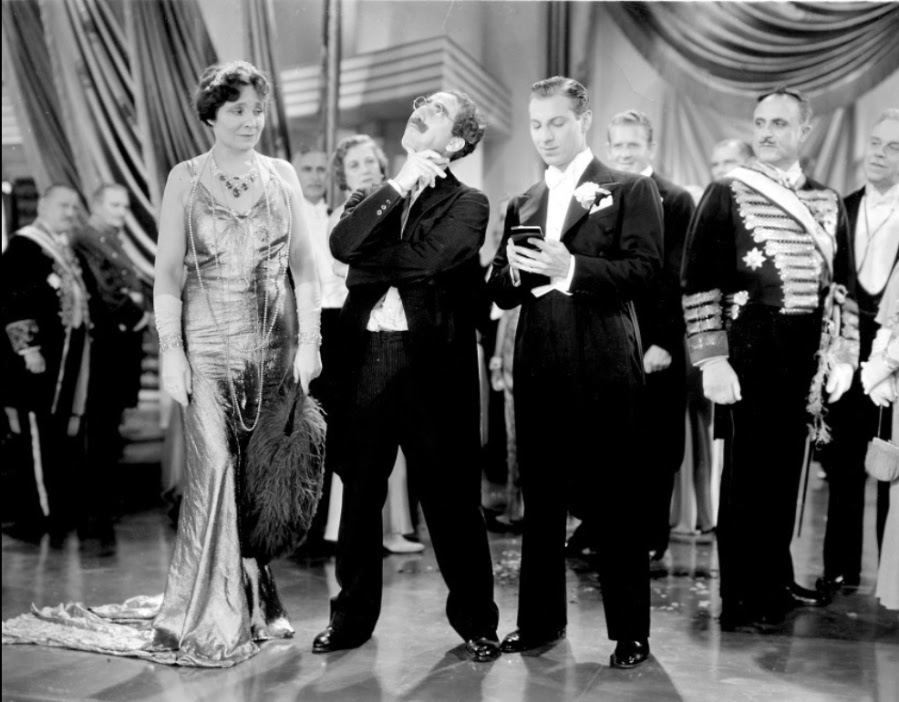
With the depression weighing on me in the evening I did the best I could to withstand it by watching the greatest comedy of all time Duck Soup (1933) McCarey. To suggest that they don’t make comedies like that anymore is a massive understatement. It’s only a shame that I’ve watched it so many times that I know the gags by heart. Imagine watching the mirror scene for the first time! I remember that when I did watch it for the first time as a child I thought it was magical, surreal and hilarious and utterly wonderful. Same with the stateroom scene in A Night at the Opera. Duck Soup was the last film the brothers Marx made before Irving Thalberg Hollywoodized them by adding sappy songs and boring love stories. The first of those films was the afore-mentioned Night at the Opera which ranks right behind Duck Soup, Horsefeathers, Monkey Business and Animal Crackers as among their best work. The subsequent films pale in comparison.


Okay so I started this Friday morning before heading off to work and I finish it now on Saturday morning. The sniffles persist but are not nearly so bad, the knee pain has also abated somewhat but clearly I need to have it checked out. I’m assuming that the doctor’s office will return my call sometime Monday. I guess they’re too understaffed to return patients’ calls. God forbid I had an emergency. The depression is gone — for now — but it lurks and one never knows when it will next strike. It’s a right bastard.


Going for a long walk in a bit. May accidentally swing by a bookstore. These things happen.

20 April 2025

Back by Popular Demand It's Films I've Watched Lately Some of Which I Loved Greatly

Walkabout

Moonstruck (1987) Jewison. Cher was brilliant and Olympia Dukakis top notch. But the rest of the cast — oh my —- talk about overacting. Director Norman Jewison tended to get broad performances in his films in this is a classic example. It’s amazing that Cher was so wonderfully restrained and I suppose if you care about Oscars, here's was well-earned. But Moonstruck is more notable for slapstick sitcom level acting from the likes of Nicolas Cage, Vincent Gardenia and Julie Bavasso. A different director could have taken the same script and made a more realistic, more believable and more compelling film. Jewison’s version felt like a case of a lot of people trying too hard. As love stories go it's terribly unconvincing. This was my first viewing since the film came out. It’ll be my last.

His Girl Friday (1940) Hawks. My favorite film. Period. It’s perfect. It’s hilarious. It’s smart. It’s innovative. It’s got some points to make (about politics and the press). It’s as perfectly-paced a movie as has ever been made. It’s got Cary Grant in one of his greatest performances (along with Mr. Lucky, Notorious and Talk of the Town). Rosalind Russell was far from the first choice to play Hildy, indeed they’d gone through most of the women in actor’s equity before “settling for” Mr. Russell. They couldn’t have done better. (That’s the kind of luck you need to make something this good.) As always in pictures from Hollywood’s Golden Age the supporting cast is crucial and here they came through with flying colors. I especially take notice of the cynical, world-weary newsmen played by Regis Toomey, Porter Hall, Frank Jenks and Roscoe Karns. And Billy Gilbert deserves plaudits for stealing his two scenes as the governor’s messenger, Joe Pettibone. His Girl Friday is like the Beatles, everything came together at the right time and right place and you can’t imagine it being any better.


The Magnificent Seven (1960) J. Sturges. Not really so magnificent. Of course I loved it when I was kid, the presence of Steve McQueen was enough to make to great picture in my mind. It was based on Kurosawa’s Seven Samurai which is to say it was re-imaging a classic. But it was ultimately a poor imitation. It would have been infinitely better if the Mexican villagers were allowed to speak Spanish, I mean beyond an occasional seƱor and gracias. All but one of those characters were cardboard cutouts. And speaking of one-dimensional characters, there were Eli Wallach and the the rest of the bandits. They were about as menacing as Yosemite Sam. And why is that the bad guys in movies back then happily ran towards gun fire? Even McQueen couldn’t save this picture. For one thing this was not the Mr. Cool we later got to know in movies such as The Great Escape and Bullit. Yul Bryner, James Coburn, Robert Vaughn and Charles Bronson were all wasted by a script that allowed for no real character development.  


Stardust Memories (1980) Allen. One of Woody’s best which is saying a lot in itself. I have no idea how many times I’ve watched the film since I saw it in Boston upon its original release. But I do know that I’ve enjoyed every viewing. I recall that some critics were miffed by how it seemingly poking fun at them. Evidence of their own thin skins and an ability to dish it out but not take it. Woody was clearly having fun spoofing everyone including himself. No one would make such a film who didn’t deep down appreciate his fans. No one would make such a film who was not introspective and thoughtful. No one would make such a film who wasn’t a comic genius. 


Walkabout (1971) Roeg. I’ve been watching Australian films on the Criterion Collection lately and though there’ve been a few misses, I’ve discovered several classic such as Picnic at Hanging Rock, My Brilliant Career and this film. Director Nicolas Roeg didn’t make much and even less that I’ve enjoyed but my goodness he hit it out of the ballpark with this look at a young brother and sister stranded in the Australian outback, ultimately finding a teenaged aborigine to guide them. It’s as beautifully shot a film as you’ll ever see and a masterclass in direction (how is it that Roeg didn’t do this more often?). It's meditative, original and a wonderful commentary on how modern culture isn't necessarily the best culture.


Action in the North Atlantic (1943) Lawson. Of course I like this picture. It honors the merchant marines serving in World War II. Though he later joined the army, my father was a merchant marine serving in World War II. He was at the helm of a ship that was torpedoed in the Arabian Sea by a Japanese submarine. So North Atlantic honors men like my dad who risked their lives to transport goods and weapons to the allies during the war. North Atlantic is — especially for a film of its era — a realistic account of what it was like to navigate seas swarming with enemy submarines. The cast is led by Humphrey Bogart and that’s a great start right there. Raymond Massey and regular supporting players like Alan Hale, Dane Clark and Sam Levene also feature. This film is one of many made during the war that was designed as war time propaganda. Like some it managed to both rally the Homefront and tell a rollicking good story.

14 August 2024

It's Time Once Again For....Movies I've Watched Lately A Few of Which I Liked Greatly

Cary Grant and Leslie Caron in Father Goose

Father Goose (1958) Nelson. I recorded this on TCM with some trepidation. I might have seen this when I was a kid but I remembered nothing about it other than it starred Cary Grant and Leslie Caron, was set during World War II on a tropical island. Would this be another of those dumb comedies from the early Sixties that were barely funny then and as dull as corduroy now? Nope. What a delight! This was Grant’s penultimate film in perhaps Hollywood's most storied film career. He turned mediocre films into good ones and good ones into great ones and great ones into classics. Father Goose is no classic but by the grace of Grant it is a thoroughly entertaining one hundred and fifty-eight minutes of cinema. It’s so much fun to see the suave and debonair Grant (the man knew how to wear a suit) playing a gruff, unshaven, sloppy beach bum turned hero. Grant plays a former history professor who wants to wile away his life on his boat but the war has gotten in the way and he’s enlisted to be an observer for the army. He does this reluctantly and even more reluctantly he rescues a woman (Caron) and the seven girls she’s in charge of. The rest is predicable such as the two principals bickering constantly then falling in love. Nonetheless it’s great fun. Everything from script to supporting characters to editing is fine, but Grant is magnificent.

Didi (2024) Wang. In the theaters now. Set and filmed in Fremont, California, it is the story of fourteen-year old Taiwanese-American lad struggling with adolescence, his family, his friends and romance. It’s a fraught age for most. Sometimes “being ethnic” complicates matters. You’re straddling being a typical American boy and being a proud member of your distinct immigrant group. A different culture and a different language are at home. You walk out the door and your like apple pie. I grew up Finnish, American and Finnish-American (yes, they’re three distinct things). I could also relate to the title character because his family was not perfectly functional, adding another layer of complication to a life. Didi is not the first film to take on a young teen’s coming of age story but it is one of the better iterations of the genre. It’s honest story-telling. Young Isaac Wang — fifteen during filming — is a budding talent who, like an experienced thespian, does  a lot of acting with his eyes which are wonderfully expressive. Often raw and uncomfortable complete with drugs, profanity and scatological references aplenty. It’s set in the summer of 2008 so social media adds another element to the young man’s story. An excellent new film.


The Last Picture Show (1971) Bogdanovich. My top 100 films list is fluid. As evidence I recently moved this masterpiece from Peter Bogdanovich into the number four spot. There’s not a false note in it. There is no better telling of small town America. It is a riveting examination of the quiet lives of desperation that so many people live, have lived, will live. There are few escapes from the drudgery, the pain, the emptiness of the small rural town that supposedly composes the heartland and the values of “real Americans.” Out of high school you can get married. That’s something to do, that’s taking a kind of control over your life. That’s adding company to your misery. That the marriage has little chance of true happiness, that it’s too early, that it’s ill-conceived is not understood. You can join the military. It’s a way to escape. You’re paid, fed, housed, perhaps taught a trade or set up for college or perhaps you lose a body part or are traumatized or pay the “ultimate sacrifice.” If you’re bold you can go off to college. And maybe you won’t come back. The Last Picture show is a snapshot of a dying town. It focuses on a group of teens graduating from high school. But we meet other members of the community. They lie, they cheat, the have affairs, but they also offer wisdom and solace and protection for the young, if not for one another. Brilliant performances highlight the film including Oscar winning turns by Ben Johnson and Cloris Leachman. The star-studded cast also includes Cybill Shepard, Jeff Bridges, Timothy Bottom, Sam Bottoms, Ellen Burstyn, Club Galager and Eileen Brennan.


From The Searchers
The Searchers (1956) Ford. Another film in my top ten. John Ford’s best which is saying something in itself. As exquisitely shot as any picture ever made. Ford’s mastery as a director was never more evident. The framing of shots, notably the opening and closing of the film, are masterful. You can't tell a good story on film without someone who knows where and how to point the camera. This often entails both a great director and cinema photographer like the duo of Ingmar Bergman and Sven Nykvist or Orson Welles and Gregg Toland or Woody Allen and Gordon Willis or John Ford and Winton C. Hoch. The Searchers is more than just great film to look at. The odious John Wayne was at his best as the racist Ethan Edwards who along with his not nephew Martin (Jeffrey Hunter) pursues the kidnapped young girl Debbie (Natalie Wood). It’s a powerful story with solid performances all around and it’s one helluva fine movie to look at.


Double Wedding (1937) Thorpe. It’s easy to make a silly movie. It’s especially easy to make a silly movie that’s also just plain stupid. But making a silly movie that’s genuinely funny is a tough ask. Double Wedding manages to pull of this rare feat. Of course having William Powell and Myrna Loy — the best man/woman screen pairing from Hollywood’s Golden Age, or any age for that matter — as your stars makes the task a lot easier. Like Grant in Father Goose, Powell is playing against type. We’re once again used to a suave and sophisticated performance — with heavy dashes of wit. But here Powell as an artist and bohemian who lives in a trailer. He’s fine in the role, thank you. Loy is sterner and more serious than usual and it’s no surprise that Powell’s character pulls her out of her shell.  The plot takes twists and turns yet manages to be predictable and yet loads of fun. 


A Place in the Sun (1951) Stevens. Meh. I suppose in 1951 when it was released and for a decade or so after A Place in the Sun was seen as an important message picture (there were a lot of those in the Fifties and most didn’t age well). Montgomery Clift, the delicious Elizabeth Taylor and Shelly Winters are the stars and all turn in admirable performances. Raymond Burr — pre Perry Mason — is over the top as the prosecutor. I’d imagine most people know this story of an ambitious young man who gets his break and starts to climb the social ladder. He climbs away from the nice girl he was with (Winters) and finds a beautiful young  socialite (Taylor) that any man would salivate over. Problem is girl number one is pregnant. Is murder afoot? There’s a bit of drama to the story but the ending is a massive letdown in too many ways to recount especially as doing so would contain major spoilers. Some people still extoll the film but I can’t imagine why. It's point --- whatever it was -- is lost on me.

18 August 2021

Observations on Westerns

Red River

I’ve been watching a lot of Westerns recently and a few things have come to my attention.

In the old west there were only two beverages that anyone ever consumed: whiskey and coffee. On the trail, cowboys, gunslingers and lawmen were forever pouring what must have been really bad coffee. There was no French Roast or lattes on the open range. Nor certainly any half and half or oat milk to splash into the cup. They would drink the coffee anytime of day including just before bed which leads one to believe there wasn’t a lot of caffeine in it (were they all serving decaf?). Tea was never offered as an alternative. Because it’s the movies, recipients received barely a third of a cup (it’s the same on TV).


Once in town heroes and villains alike drank whiskey. Indeed they never seemed to have to specify what they wanted suggesting that whiskey was the only beverage on offer. No martinis, no gin and tonics no tequila sunrises and no frickin’ ice in drinks, no water or soda to cut it either and no beer back. Straight whiskey and you often got a whole bottle. Some people drank copious amounts without slurring words, wobbling or otherwise indicating that they’d gotten so much as a buzz. Yet there was often a town drunk around either for comic purposes or to provide a pitiable figure. Sometimes the drunk was an otherwise respectable figure, like Thomas Mitchell in Stagecoach (1939) Ford. Fun but flawed.


Another thing one notices in westerns is the reliance on horses. This was true in most of the U.S. until a decade or two into the 20th century. Horses were ubiquitous and absolutely necessary to anyone who wanted even the slightest bit of independence in their comings and going. Of course in films real horses are used and one gets a sense of the tremendous burden placed on these animals. Those horses got a helluva work out. Only in some movies do characters acknowledge that horses need food, water and rest.


Another feature of the Western is the bad guy. My goodness they could be really damned bad. Some of the cruelest, most sadistic villains on screen are in Westerns. Cutthroats, cheaters, rapists, sadists, cold-blooded killers. Surely such unpleasant characters roamed the west but one assumes they were not nearly so ubiquitous. An occasional flaw in Westerns is how one-dimensional villains are. They’re rotten through and through and that’s about all there is to them. 


Native Americans are of course standard fare in westerns. This is often sad, reflecting as it does the racism that permeated not only those times depicted but the racism extant when the film was made. Mostly Indians are portrayed as murderous savages — “hostiles” — who for unfathomable reasons seem to want to kill every white person they see. They are also shown to be extremely stupid in battle, exposing themselves to gunfire as they wildly charge their well-armed and often fortified defenders. (In realty, most native warriors were adept fighters who did not stupidly march straight into gunfire). 


Some Westerns have sympathetic Indians, although a few are sell-outs betraying another tribe to serve their own purposes. But other films have the proverbial cowboys and Indians getting along companionably or at least forming alliance against more warlike tribes such as the Apaches or Comanches.


Little Big Man (1970 Penn and Dances With Wolves (1990) Costner were two films that flipped the script and made whites the bad guys and the Natives heroes. It was long, long overdue and arguably a case of too little too late.


The manner in which Native Americans are depicted in films can be a deal breaker for people considering watching a Western and I can understand that. As a life-long student of U.S. history I have the advantage of knowing a fuller truth about the treatment of Native tribes (it was just this side of genocide) and armed with the truth can appreciate films for what they are. I was always hesitant about showing my children Westerns and when I did made sure they understood the reality of the situation. 


One thing I like about Westerns is they generally extoll the common man (and the more independent sorts among them) while vilifying the rich and powerful. See again John Ford’s Stagecoach — perhaps the quintessential Western — in which the real bad guy is the wealthy banker who absconds with the payroll. My oh, oh my you should hear this self righteous, bloviating, pompous swindler go on. He complains about taxes. He complains about government regulations. He insists on this and demands that. He looks down on drunks, whores, Indians and Mexicans and anyone else not up to his lofty standards. All the while there's a bag full of ill-gotten loot sitting on his lap.


He gets his comeuppance as the moneyed class often does in Westerns.


Westerns also recognize that some lawmen are corrupt, cruel or incompetent. (In other words no one is spared in Westerns). Usually they get their just desserts from the hero of the story.


Women are treated surprisingly well in Westerns. While men, of course, do the overwhelming majority of the fighting, dying, killing and are the bosses, there are many an independent woman in such films unhesitant about holding a rifle and even pointing it in the right direction. In Red River (1948) Hawks Joanne Dru stands up to two stubborn men and makes the two chuckleheads see reason. Simply put she doesn’t put up with any bullshit.


Westerns also feature an inordinate share of brawls with participants exchanging punch after punch, breaking chairs over one another and tossing opponents through windows. After the dust has cleared the fighters seem little worse for the wear, usually a small stream of blood pouring out of the side of a mouth and a torn shirt. If you bother to think about it, it’s damn silly. Brawls and fistfight, primarily because of their lack of realism, are usually my least favorite part of the story.


So why do I love a good Western? The simple answer is that I like any movie, regardless of genre, that is well-made. Westerns often are gorgeous to look at. The wide open spaces, the canyons, mountains, forests, deserts make for compelling backdrops and can even be part of the story itself. Westerns also can be good at exploring the human psyche. While it is true that villains can be one-dimensional characters, many Western protagonists are complex characters whose motives are conflicted. See for example Jimmy Stewart in the Naked Spur (1953) Mann and John Wayne in The Searchers (1956) Ford. In Budd Boetticher’s string of Westerns Randolph Scott stars and his outwardly simple leading man often betrays a more nuanced character. Red River is rich in interesting characters, beyond the already-mentioned leads (Wayne and Montgomery Clift). 


Westerns also evoke a romantic time in American history when the frontier was not yet closed. Possibilities seemed endless for the enterprising pioneer whether an individualist or part of a collective. But danger lurked. There were the ever-present criminal element, natural hazards, and in the parlance of the time — the untamed savages.


Many characters in Westerns have big dreams. They're going to settle down, get married. Maybe start ranching or farming. They want to get away from their past and live in some place new. In The Gunfighter (1950) King, Gregory Peck's Jimmy Ringo wants to settle in California or the Pacific Northwest or hell, even Mexico, just so long as he can get away from lawmen and young gunslingers who want to test his reputation. Like so many Western characters he longs for a fresh start. Of course such characters face obstacles. Fate will intercede. 


A good Western has engaging characters placed in difficult situations, that’s a simple recipe for a good story and one you’ve got settings like Monument  Valley in the background you’re all set.


27 April 2021

Comparing Films Not Always Easy, But I Do it With Three Westerns

John Wayne and Montgomery Clift in Red River

In the summer of 1998 I was talking with a friend of mine who’d recently seen an obscure film about Native Americans called Smoke Signals (1998) Eyre. He told me that he liked it better than Saving Private Ryan (1998) Spielberg, another recent release. I found this an extremely odd comparison and was tempted to ask how he thought Smoke Signals compared with Casablanca (1942) Curtiz. Other than the fact that they were new films Smoke Signals and Saving Private Ryan had nothing in common. In some respects it’s akin to saying that you prefer the orange you just ate to the spaghetti dinner from last night.
 They're both food but....

Comparing films, however much you stretch it, is what people do. It is what the Oscars are all about. Five acting performances are nominated, voters compare and pick the one they think is best. Never mind that Anthony Hopkins playing a man with dementia in The Father (2020) Zeller is a totally different process than Riz Ahmed portraying a young recovering addict who has lost his hearing in Sound of Metal (2019) Marder


But surely some comparisons make more sense than others. Comparing Bridge on the River Kwai (1957) Lean with Schindler’s List (1993) Spielberg because they are both set during World War II doesn’t make a lot of sense. You may like one a lot better than the other but more likely you enjoy them for different reasons (or I suppose dislike them for different reasons). Speaking of Saving Private Ryan and the year 1998, I had another friend say he preferred The Thin Red Line (1998) Malick over Ryan, both were released around the same time. Though I disagreed with him, his comparison at least made sense as there were enough similarities to warrant a comparison. 


Certainly comparing Sean Connery as James Bond with portrayals by Roger Moore, Pierce Brosnan and Daniel Craig is valid. Just as are comparisons of the different versions of films like True Grit, 3:10 to Yuma and The Getaway. A Night to Remember (1998) Baker and Titanic (1997) Cameron lend themselves to comparison as they are both about the same event.


Returning to ’98, it would have made more sense for my friend to have simply said how much he liked Smoke Signals and leaving the Spielberg film out of it. If he really needed to compare it to something he could have chosen other films that are about Native Americans.


All this has been a perhaps overly lengthy preamble to allow me to compare some films.


On Sunday I watched Silverado (1985) Kasdan a movie I hadn’t seen since its initial release over three decades ago. I had no recollection of my response to the film and have been meaning to re-watch it for years. I shouldn’t have bothered. It was not only a mediocre film (that’s being charitable) it suffered badly in comparison to the movie I’d watched the day before, Red River (1948) Hawks


I believe it valid to compare the two films because they are both Westerns. 


Silverado is a series of shootouts between very bad guys (why they all weren’t wearing black hats is a mystery) and very good guys (and why didn't they all don white hats?). The bad guys all got killed. The good guys all survived. There were moments of supposed tension but the film was such that one never worried about the outcome. Everything was perfectly predicable up to including an ending that I saw a mile way. But Silverado’s biggest offense was the one dimensionality of its characters. It was a terrible waste of a good cast led by Kevin Kline, Kevin Costner, Scott Glenn and Danny Glover. Not a one of them was nuanced.


Red River is all about character. As Thomas Dunson, John Wayne got one of the few roles he was really able to sink his teeth into and show his acting chops (limited as they were). The Dunson we initially meet is heroic, brave and determined. The man he turns into is cruel, paranoid and dangerously stubborn. There is great complexity to him and his relationship with his adopted son Matt Garth played perfectly by Montgomery Clift. Red River is a western epic with incredible scenes of a lengthy cattle drive from southern Texas to Kansas, replete with bad weather, stampedes, playful banter, conflict and the inevitable Indian attack. 


As Red River reaches its denouement viewers marvel at the incredible journey and wonder at how the central conflict between Dunson and Garth will resolve itself. 


Perhaps I was wrong, maybe you can’t compare Silverado with Red River as there is no comparison.


Paul Newman in Hud
Yesterday I watched a more modern Western, set in the early 1960s, Hud (1963) Ritt. I don’t know that it warrants comparison with Silverado or Red River but if so it far surpasses the former and is in the rarefied air of the latter. 

Paul Newman plays Hud, as self-centered and amoral a character as has ever been on screen. But audiences took to Hud the character and thus the movie. They actually liked Hud, most likely because he was played by one of the handsomest and most magnetic actors of all time. But also because, among his other undeniable characteristics, was cynicism. Cynics make for good film characters because they don’t ask audiences to believe in anything and indeed support their questioning of a lot. Hud is also a maverick and a womanizer and what film-goer can pass on someone like that when played by a blue-eyed beauty.


The cast also includes Oscar-winning performances by Melvyn Douglas and Patricia Neal. The later brings an interesting sort of sensuality to her role as the common but wise maid employed by the three ranchers (Grandpa, Hud and teenaged Lonnie played ably by Brandon De Wilde). Newman was nominated for an Oscar but lost to Sidney Poitier.


The film Hud is ostensibly about a successful cattle rancher who must face losing his entire herd to hoof-and-mouth disease. When the possibility of the herd being infected is first presented, Hud suggests selling off the herd to unsuspecting buyers. That’s his moral compass in a nutshell. And here he expresses it: “This country is run on epidemics, where you been? Price fixing, crooked TV shows, inflated expense accounts. How many honest men you know? Why you separate the saints from the sinners, you're lucky to wind up with Abraham Lincoln. Now I want out of this spread what I put into it, and I say let us dip our bread into some of that gravy while it is still hot.”


But Hud is a multi-layered film as most great ones are (and it is, in my estimation, a great film). It is about family, regrets, hidden resentments and open resentments. Lonnie is in some way the central character. He is torn between an abiding love for his charismatic Uncle Hud and his own basic goodness, doubtless inherited from his grandfather. Lonnie yo-yos back and forth between wanting to raise hell with Hud and do the right thing. He makes his choice at the end of the film. 


Neal’s Alma Brown is also crucial to the story’s arc. She is the oft-bemused observer, offering wry comments while tirelessly supporting the men. Hud and Lonnie both lust after her and who wouldn’t? She is all long legs, bare feet, a lithe body capped by smoldering smiles. 


Hud and Red River are exceptional films centered around complex characters in trying circumstances. Other than being Westerns, they are not easy films to classify. That’s a good thing. 

15 October 2020

Movies That Make Me Cry (Actually None Do, But Some Choke Me Up -- A Little)

Tom Hanks and Denzel Washington in Philadelphia

I recently saw a filler on TCM in which the hosts each shared which movie makes them cry. Naturally this prompted me to think of movies that cause me to sob. Well cousin, first of all I don’t do crying. I’m not proud of this. It's on my long list of emotional issues. From the time I was a small child until my late teens, I didn’t cry a drop. Not a single tear. There wasn’t a lot of blubbering going on in my twenties, thirties of forties for that matter. Deaths of kin and good friends has caused the waterworks to get going but I’m unable to sustain it for very long. (In other words, I'm a typical Finn.) But at least there’s something. So shedding a tear or two over something like a movie is pretty rare but it has happened. Sports causes me to tear up a bit, such as when the Giants finally won the World Series. But again we're talking getting choked up not bawling. All that being said I thought I'd share some movies that — while they don’t make me cry, nor necessarily even shed a tear -- can at least get a good-sized lump going in my throat.

(Warning: there are spoilers aplenty to follow.)

Philadelphia (1993) Demme - I’m sure I’m not alone here. It’s a superbly done movie and the ending -- which some stone hearts might call emotionally manipulative, is natural and essential to the story. Plus it gets me every time. I used to show Philadelphia as part of a two-week-long unit on Homophobia my middle school used to do and at the end of the movie I’d always have to look away. It wouldn’t do for students to see their teacher red-eyed -- espeically because of a movie. A large part of the emotional impact of the film comes from Tom Hanks' transcendent Oscar-winning performance as Andrew Beckett, the gay lawyer with AIDS.


The Searchers (1956) Ford Saw it recently and the ending got to me again. The wife mistakenly thought this was a reaction to the character of Ethan Edwards being left all alone while everyone else was happily grouped together. That contributes to the effect but it’s really all about the exquisite beauty of the final shot and how it bookends the opening shot and draws to a close the epic story. Perfection in film often touches me emotionally as happened when I last watched Dog Day Afternoon (1975) Lumet and Chinatown (1974) Polanski.


It’s A Wonderful Life (1946) Capra Something of a cliche to be sure and actually I’ve seen it so many times that the power to choke me up is pretty much gone, but it did the trick for years. It is a heart-tugger of a story with a man realizing how rich his life how much he's loved and how lucky he is. I think about it sometimes when in a blue mood.


Sean Penn as Milk
Milk (2008) Van SantWhile an inspiring story, it is also unquestionably a sad one and the ending captures that. But it gets me also because I remember those times and how so many of us were so powerfully struck by the assassinations of Harvey Milk and Mayor George Moscone. This is another film highlighted by a bravura Oscar-winning performance, this time by Sean Penn as the title character.

Au Revoir Les Enfants (1987) Malle — Heroism. Injustice. Youth. The rending of a youthful friendship is tough, when it’s done in the name of genocide it is brutal. It is a great film with an emotionally powerful ending.


Umberto D (1952) De SicaIt’s the one work of Italian Neo-realism that most moves me emotionally. In fact I feel like pitching forward and crying like a baby right now just thinking about the ending and the wonderful character of the old man and his love for his dog. It is a movie stripped of sentimentality being instead a powerfully real slice of life


Ride the High Country (1962) Peckinpah I refer to the death of Joe McCrea’s character a noble man if there ever was one  (he utters one of my favorite lines in all of filmdom: I want to enter my house justified). It’s a cruel fate for such a good man.


The Last Picture Show (1971) Bogdanovich There is a pervasive sadness to this film (a true American classic) and it really comes to the fore in certain scenes. Learning of the death of Sam the Lion (Ben Johnson), the final emotional outburst by Ruth Popper (Cloris Leachman), the death of Billy (Sam Bottoms) and the final parting of Sonny (Tim Bottoms) and Duane (Jeff Bridges). A lot of moments in Picture Show tug at my heartstrings.


Giulietta Masina 
Nights of Cabiria (1957) FelliniAs with most films that get to me, it is the ending. I’m not so much moved by the injustice of what happens to the title character, played by Giuletta Masina, but the beautiful way she responds to it. Surrounded by joyous people she slowly breaks into a soft, tearful smile. It's one of the greatest moments in movies.

The Big Parade (1925) Vidor There are two scenes that get me every time. The first is when the protagonist, James (John Gilbert) goes off to battle leaving behind the French farm girl, Melisande (Renee Adore). She chases the truck he is on as through their tears they blow kiss after to kiss to one another and James tosses her gifts. Meanwhile soldiers march past her. The truck eventually picks up speed and Melisande is left disconsolate on the road. The second scene is the conclusion when they re-unite. James’ return to France and rediscovery of his lost love is no surprise but in the hands of an artful director like King Vidor, it is grand film moment.


Radio Days (1987) Allen -- It’s not just a celebration of when radio was king, it is a celebration of childhood, family and nostalgia. It’s a wonderful film and it touches me in a million ways and by the end I could have a good cry. (I don’t, but I could.) 


05 October 2020

How About a Double Feature? Part Two

Ivan's Childhood 

Regular readers of this blog (Gadzooks Dingleberry of Caribou, Maine) may recall that last July I posted 12 recommendations for double features. The response was whelming. I've imagined literally millions of you asking for more (while in reality thousands have asked for less). So today I am proud to offer a more modest list of ten double features to help you get through those long, lonely Autumn nights as we await Election Day. Once again I looked for interesting couplings with a common thread. I've got comedies, war pictures, Shakespeare, Western, silent, Marx Brothers and drunks. Hope you find something you like. Tell your friends and get ten percent off at your next gift shop purchase.

Ivan’s Childhood (1962) and Come and See (1985) Young Soviet lads fight World War II. Russian cinema has created some great films about World War II which is not at all surprising given the massive impact the Nazi invasion had on the then Soviet Union. Two of the best are films whose main characters are a pre-adolescent and a teen. Ivan's Childhood, directed by my favorite Russian director, Andrei Tarkovsky, follows the exploits of Ivan, who scouts for the Soviet army in their campaign against the Nazis. He has suffered horrific personal losses and hates the German invaders with an understandable vengeance. Young Ivan is a very serious young man, self possessed and fearless. In Come and See a young teen named Alexsey joins the partisans in Belarus to fight the invading Nazi hordes. Soon after his family is slaughtered. Like Ivan, he has a special purpose. These are two extraordinary films and are masterpieces of cinematography. The beauty of many shots help illuminate the horrors of war. War is an often used subject in cinema. Sometimes battle is romanticized and the slaughter sanitized or even glamorized. Not so in these two films that evoke the true horror of war while providing completely watchable, compelling viewing experiences.

Chimes at Midnight (1965) and My Own Private Idaho (1991)A Little Falstaff Anyone? One of William Shakespeare's most memorable characters is that of Falstaff who appeared in three of his plays (Henry IV Parts one and two and Henry V). He is mostly a comic figure, an overweight, conceited, boastful, and cowardly knight. He's also a notorious lush who can regularly be found drinking at the Boar's Head Inn with petty criminals. Not a very good influence on Prince Hal (who is later King Henry). Orson Welles wrote and directed Chimes and he is masterful in the role of Falstaff. Made in 1991, My Own Private Idaho is set in present day but based on the Shakespeare plays above mentioned. Keanu Reeves stars as the Hal-like Scott Favor. The Falstaff fill-in is called Bob Pigeon (William Richert). Idaho was written and directed by Gus van Sandt who was inspired by Chimes. Idaho also features River Phoenix in perhaps his best role. It is considered a landmark in New Queer Cinema. It's gay themes and modern settings are among the only things that differentiate it from Chimes. Both are superb films.

The Lost Weekend
The Lost Weekend (1945) and Come Back Little Sheba (1952)Struggles with booze. In Lost Weekend, Ray Milland is an unrepentant drunk who, when given the opportunity, goes on the bender of all benders. In Come Back Little Sheba, Burt Lancaster is in recovery but despite a loving wife and being in AA, falls off the wagon. Good and hard. Both films accurately capture how the disease of alcoholism ravages the individual and those around him. Weekend is much the better of the two films showing the insidiousness of the disease and how helpless one can feel in fighting it. Sheba has its virtues too and I recommend it because of its hopeful message.

The Freshman (1925) and Horse Feathers (1932) Rah! Rah! Rah! It's the day of the big game. Maybe your favorite team is playing right now despite the pandemic or maybe the start of their season has been delayed. In any case many people can't get enough college football with its pomp, pageantry, traditions and predilection for the unexpected. Why not combine a rollicking comedy and a favorite sport? With The Freshman you get the bespectacled and hilarious Harold Lloyd worming his way onto the college team and ultimately getting on the gridiron for the climactic moments of the big game. Lloyd plays, of course, a freshmen and he is an oft-ridiculed nebbish one at that. But you'll love his earnestness and root for him to win the girl and glory on the field. Horse Feathers features all four Marx Brothers in my second favorite of all their films. Like Lloyd they provide laughs aplenty and also insinuate themselves into the big game and of course star in the dramatic climax. Of the foursome only Zeppo is actually a student, although how he has any eligibility left given that he's been a student for a decade, is an open question. Groucho is not only not a student, he's the president of the university. Horse Feathers is a laugh fest and like The Freshman, provides succor to those who miss college football.

The Bride of Frankenstein (1935) and Gods & Monsters (1998) -- The Making of a Monster. James Whale directed the former and is a character in the latter. To me, Bride was Whale's masterpiece (and he made several excellent horror films). It is not a film that will frighten modern audiences, indeed it has high camp value, particularly in the form of Dr. Pretorious (played by the always delightful Ernest Thesiger). Boris Karloff is the monster and the scenery chewing Colin Clive is the doctor. Elsa Lanchester has a small but memorable role as the title character. Gods and Monsters explores Whale's last days and Ian McKellan is perfect as Whale. Whale takes in young gardener (Brendan Fraser) who he is smitten with. G&M is funny, touching, sentimental, heartbreaking and utterly lovable. In the course of the story, Whale watches Bride and dishes on his stars. G&M also explores the difficulties of being gay in what was then a closeted America (Whale was gay).

8 1/2 (1963) and Stardust Memories (1980) Film director in turmoil. In 8 1/2 Marcello Mastrioni plays a director based on actual director, Federico Fellini. In Stardust, Woody Allen plays a director based on himself who is also the director of the film. They are happy men but plagued by angst and the vagaries of fame and the women they love and the women who love them. Both directors are trying to relax, Mastrioni after his latest hit, Allen after another squabble with studio executives. They hope that getting away for a bit will help, but there is no escape the trappings of fame and the myriad individuals who come with it. While 81/2 is very much an autobiographical film for Fellini, Stardust Memories is very much an homage to 8 1/2, although it certainly reflects some of Allen's own experiences. In both films there are laughs, romance, pathos and excellent cinematography.

Ed Wood
Ed Wood (1994) and The Disaster Artist (2017) True stories of bad directors who accidentally made cult classics. Both films are based on film directors who were at the very bottom of the their fields. Ed Wood was famously, bad having made that rare film that is so bad it really is good: Plan Nine From Outer Space. Johnny Depp, in one of his best performances, plays the cross-dressing Wood. Tim Burton directed and it is far and away my favorite of his films. Martin Landau turned in an Academy Award winning performance (best supporting actor) as Bela Lugosi. The Disaster Artist chronicles the rise to "fame" of Tommy Wiseau who directed another so bad its good film, The Room. James Franco gives a bravura performance as the very weird Wiseau. Franco also directed. Both as director and actor, Franco captures the wildly eccentric main character and the wild and true story of the making of The Room. Taken together you have two films about men who gained notoriety through their ineptitude. Both are thoroughly entertaining, funny, yet at times touching.

If….(1968) and Rushmore (1968) Iconoclastic Teens. Admittedly Mick of If.... and Max of Rushmore are very different kinds of blokes but both were unique among their peers and very much rebels of their times. Mick is cool, unconventionally handsome and a free spirit who wants to blaze his own trails. Max is a dweeb, nerdy-looking and inappropriate but wants acceptance and admiration. Mick is in a stuffy British boarding school circa the late Sixties. Max is in a stuffy American private school then a typical American high school circa the late Nineties. Both fall in love, both have a small support group and both stay true to themselves throughout and in very different ways get what they want. If... was a touchstone of the Sixties and the spirit of rebellion then personified. That is to say, it was an important film. Rushmore was less significant culturally but a important cinematically, cementing as it did the unique style of director Wes Anderson as a significant new voice in film.

The Great Escape (1963) and La Grande Illusion (1937)Let’s get out of here. Both film features one of filmdom's coolest stars busting out of prisoner of war camps. The Great Escape is the true story of an allied blitz out of a German stalag in the middle of World War II. Steve McQueen -- who personified cool for two decades -- is one who escapes and is one of many to be re-captured. But not before a thrilling motorcycle chase. In Grand Illusion, Jean Gabin, who had a long career being cool in French films, also escapes from a German POW camp, in this case during World War I. The movies are different in tone, settings and themes (Grand Illusion also looks at classism and the waning days of European aristocracy). The Great Escape is much more of an action film and is based on actual events. It also deals more with the details of affecting an escape and the consequences to both sides. The main thing the two have in common is that they're great films with magnetic stars leading excellent casts.

Destry Rides Again (1939) and Mr. Smith Goes to Washington (1939) -- Jimmy Stewart as unlikely hero. As Destry, Jimmy Stewart is the soft-spoken story-telling sheriff who cleans up the corrupt town of Bottleneck (state unknown). As Smith, he is the naive and patriotic senator who cleans up an entire state (the identity of which is unknown). Stewart was a classic kind of American hero. Tall and gangly, intelligent but humble and seemingly non-threatening. He always got the girl and he always exposed the bad guys -- despite the odds. In both these films the cynics and wise guys laughed at him, until, that is, they celebrated him as hero. Destry is a delightful film featuring the contrasting pair of Stewart and the sultry Marlene Dietrich. Brian Donlevy is the "businessman" who runs the town and lines his pockets along the way. Mr. Smith is a cinematic classic in which the titular character (aided by the love and counsel of Jean Arthur's character) takes on the corrupt "businessman" played by Edward Arnold, who runs an entire state, profiting greatly along the way. While Destry is played mostly for laughs (which it achieves), Smith explores the darker side of Washington politics. Stewart excels in both films.
24 May 2020

Ten Lists of Ten Films For Your Memorial Day Enjoyment

Au Revoir Les Enfants
My Ten Favorite French Films
1. Au Revoir Les Enfants (1987) Malle
2. La Haine (1995) Kassovitz
3. Le Silence de la mer (1949) Melville
4. La vie de Boheme (1992) KaurismƤki
5. Vivre Sa Vie (1962) Godard
6. Shoot the Piano Player (1960) Truffaut
7. The Discreet Charm of the Bourgeoisie (1972) Bunuel
8.  La Grande Illusion (1937) Renoir)
9. Port of Shadows (1938) Carne
10. Cold Water (1994) Assayas

My Ten Favorite Films That Feature Robert De Niro
1. Goodfellas (1990)  Scorsese
2. Taxi Driver (1976) Scorsese
3. Raging Bull (1980) Scorsese
4. The Godfather: Part II (1974) Coppola
5. The King of Comedy (1982) Scorsese
6. Mean Streets (1973) Scorsese
7. The Deer Hunter (1978) Cimino
8. Jackie Brown (1997) Tarantino
9. Silver Linings Playbook (2012) Russell
10. Heat (1995) Mann

My Ten Favorite Films By Female Directors
1. The Virgin Suicides (1999) S. Coppola
2. The Ascent (1977) Sheptiko
3. We Need to Talk About Kevin (2011) Ramsay
4.  Wanda (1970) Loden
5.  Cleo fFrom 5 to 7 (1962) Varda
6.  Wings (1966) Shepitko
7.  Mustang (2015) Erguven
8.  Europa Europa (1990) Holland
9.  Wendy and Lucy (2008) Reichardt
10. Peppermint Soda (1977) Kurys

Heaven's Gate
My Ten Favorite Westerns
1. Heaven’s Gate (1980) Cimino
2. The Searchers (1956) Ford
3. Stagecoach (1939) Ford
4. The Wild Bunch (1969) Peckinpah
5. Red River (1948) Hawks
6. McCabe and Mrs. Miller (1971) Altman
7. My Darling Clementine (1946) Ford
8. Little Big Man (1970) Penn
9. The Big Trail (1930) Walsh
10. Butch Cassidy and the Sundance Kid (1969) Hill


My Ten Favorite Bergman Films
1. Winter Light (1963) 
2. The Seventh Seal (1957)
3. Fanny And Alexander (1982)
4. Persona (1966)
5. Through A Glass Darkly (1961) 
6. Shame (1968) 
7. Silence (1963) 
8. Wild Strawberries (1957)
9. The Virgin Spring (1960) 
10. Cries & Whispers (1972)

The Ten Films I've Watched the Most*
1. It’s a Wonderful Life 1946) Capra
2. Christmas in Connecticut (1945) Godfrey
3. Manhattan (1979) Allen
4. Annie Hall (1977) Allen
5. The Great Escape (1963) J. Sturges
6. Mr. Smith Goes to Washington (1939) Capra
7. Duck Soup (1933) McCarey
8. Mean Girls (2004) Waters
9. Casablanca (1942) Curtiz
10. Goodfellas (1990)  Scorsese
*This is merely a guess, I have no empirical data here.

My Ten Favorite Films Made in the 1920s
1. Sunrise (1927) Murnau
2. The Big Parade (1925) Vidor
3. La passion de Jeanne d'Arc (1928) Dreyer
4. The Gold Rush (1925) Chaplin
5. Battleship Potemkin (1925) Eisenstein
6. A Woman of Paris (1923) Chaplin
7. The Crowd (1928) Vidor
8. Diary of a Lost Girl (1929) Pabst
9. The Last Laugh (1924) Murnau
10. The Lodger (1927) Hitchcock

A  Clockwork Orange
My Ten Favorite Films Based on Novels I've Enjoyed
1. A Clockwork Orange (1971) Kubrick
2. The Grapes of Wrath (1940) Ford
3. The Big Sleep (1946) Hawks
4. No Country For Old Men (2007) Coens
5. All Quiet on the Western Front (1930) Milestone
6. The Exorcist, (1973) Friedkin
7. Jaws (1975) Speilberg
8. The Maltese Falcon, (1941) Huston
9. Fight Club (1998) Finchner
10. The Long Goodbye (1973) Altman

Ten Excellent Films With Brilliant Performances By a Female Lead
1. Sunset Blvd. (1950) Wilder -- Gloria Swanson
2. The Lady Eve (1941) Sturges -- Barbara Stanwyck
3. Shame (1968) Bergman -- Liv Ullman
4. Blue Jasmine (2013) Allen -- Cate Blanchett
5. A Woman Under the Influence (1974) Cassavetes -- Gena Rowlands
6. Nights of Cabiria (1957) Fellini -- Giulietta Masina
7. Cabaret (1972) Fosse -- Liza Minelli
8. Red Desert (1964) Antonioni -- Monica Vitti
9. Stromboli (1950) Rossellini -- Ingrid Bergman
10. Winter’s Bone (2010) Granik -- Jennifer Lawrence

Ten Great Films with Cast Members From Casablanca
1. Treasure of the Sierra Madre (1948) Huston -- Humphrey Bogart
2. Viaggio in Italia (1954) Rossellini, -- Ingrid Bergman
3. Mr. Smith Goes to Washington (1939) Capra -- Claude Rains
4. The Maltese Falcon (1941) Huston - Sydney Greenstreet
5. M (1931) Lang -- Peter Lorre
6. Christmas in Connecticut (1945) Godfrey -- S.K.Sakall
7. The Grapes of Wrath (1940) Ford --  John Qualen
8. The Talk of the Town (1942) Stevens -- Leonid Kinksey
9. La Grande Illusion (1937) Renoir -- Marcel Dalio
10. 8 1/2 (1963) Fellini -- Madeleine Lebeau